

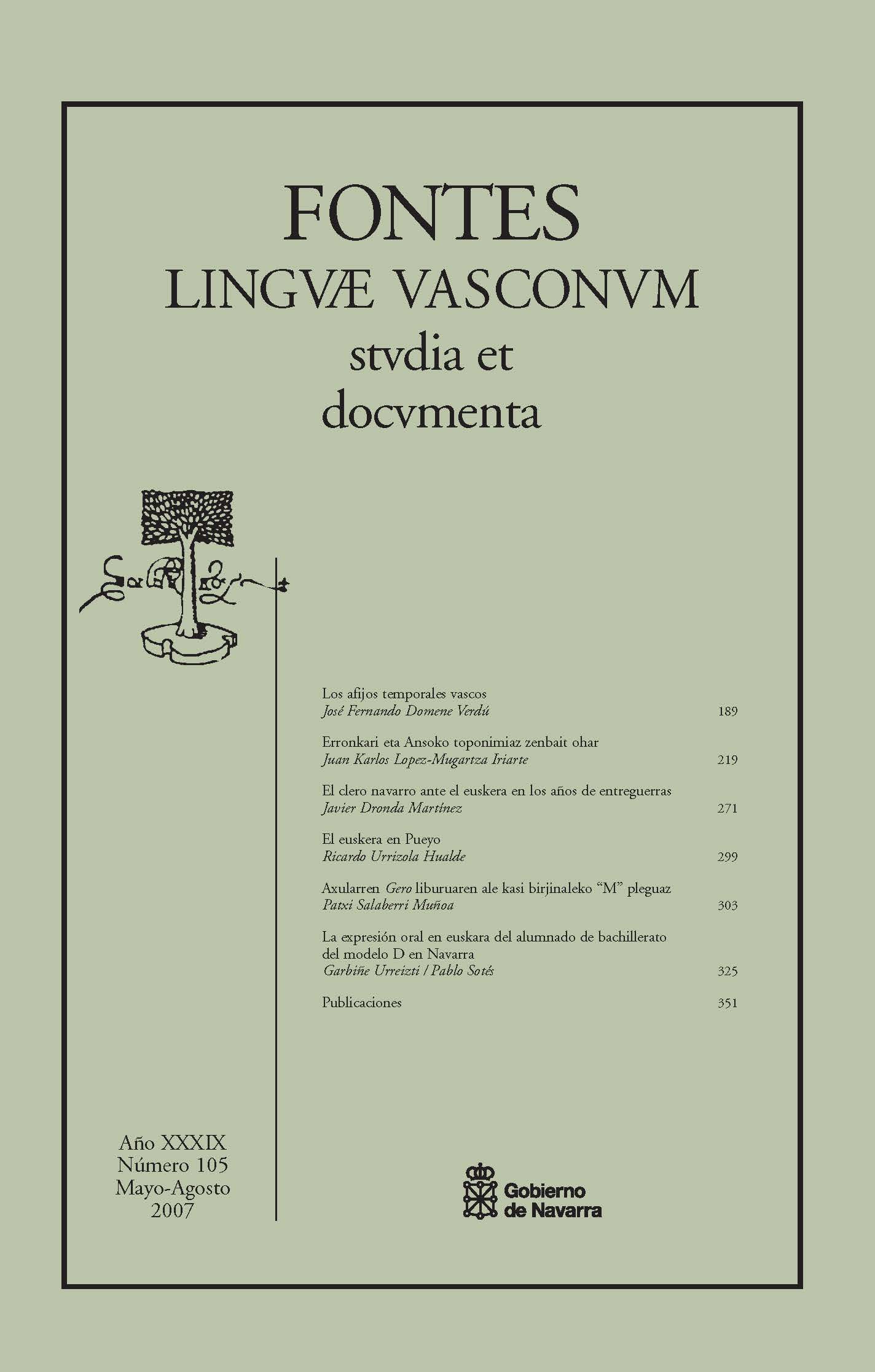
La expresión oral en euskara del alumnado de bachillerato del modelo D en Navarra
Abstract
Oral expression is one of the main language skills in the production of a language and the indicators of progress and command when learning a second language (L2). The oral expression of L2 learners is characterised by a succession of stages which each student passes before reaching oral competence in the language. This article studies the oral expression in Basque of students studying in Navarre’s language model D on finishing their 1st year of “bachillerato” (High school). These students, whose mother tongue is either Basque or Castilian or both, have studied in the Basque language throughout the different stages of their formal education. More specifically, the aim is to analyse the language quality of students in the oral expression test which forms part of the examination certifying the superior study level in Basque set by the Official Navarrese Distance-learning Language School. The frequency and distribution of mistakes in oral production were correlated to the language area the education centres were based in. The results highlight the need to include a cross-curricular programme aimed at the formal use of the language in the curriculum
##about.statistics##
References
CORDER, S. P. (1967), "The significance of learners' errors", IRAL, 5, 161-170. https://doi.org/10.1515/iral.1967.5.1-4.161
DICKERSON, L. (1975), "The learner's interlanguage as a system of variable rules", TESOL Quartely, (9)4, 401-407. https://doi.org/10.2307/3585624
ELLIS, R. (1994), The estudy of Second Language Acquisition, Oxford, Oxford University Press.
Fernández, S. (1997), Interlengua y análisis de errores en el aprendizaje del español como lengua extranjera, Madrid, Edelsa.
OROZ, N. y SOTÉS, P. (2006), "Hezkuntza elebiduna Nafarroan: Elebakartasunetik eleaniztasunera", en J. CENOZ y D. LASAGABASTER (eds.), Hizkuntzak Ikasten eta Erabiltzen, Bilbao, Servicio Editorial de la Universidad del País Vasco, pp. 37-58.
PALMER, D. (1980), "Expressing Error Gravity", English Language Teaching Journal, 2, 93-96. https://doi.org/10.1093/elt/34.2.93
RICHARDS, J. (ed.), (1974), Error Análisis: Perspectivas on second language acquisition, Londres, Longman.
RUIZ BIKANDI, U. (2000), Didáctica de la segunda lengua en educación infantil y primaria, Madrid, Síntesis.
SELINKER, L. (1972), "Interlanguage", IRAL, 10, 209-231. https://doi.org/10.1515/iral.1972.10.1-4.209
SHUMANN, J. H. (1978), The pidginisation Hipótesis: A model for Second Language Acquisition, Rowley, Mass., Newbury House.
SOTÉS, P. (2000), "Uso y adquisición de la segunda lengua en un programa de inmersión: Diferencias individuales", Infancia y Aprendizaje, 92, 29-49. https://doi.org/10.1174/021037000760087766
SOTÉS, P. y OROZ, N. (2005), "El tratamiento de las lenguas en Navarra", en X. RODRÍGUEZ YÁÑEZ; A. M. LORENZO y F. RAMALLO (eds.), Bilingualism and Education: From the Family to the School, Muenchen, Lincom.
TAYLOR, B. (1975), "Adult language strategies and their pedagogical implications", TESOL Quartely, 9, 391-399. https://doi.org/10.2307/3585623
VILÀ I SANTASUSANA, M. eta al. (2005), El discurso oral formal. Contenidos de aprendizaje y secuencias didácticas, Barcelona, Graó.
Copyright (c) 2007 Garbiñe Urreizti, Pablo Sotés

This work is licensed under a Creative Commons Attribution-NonCommercial 4.0 International License.