

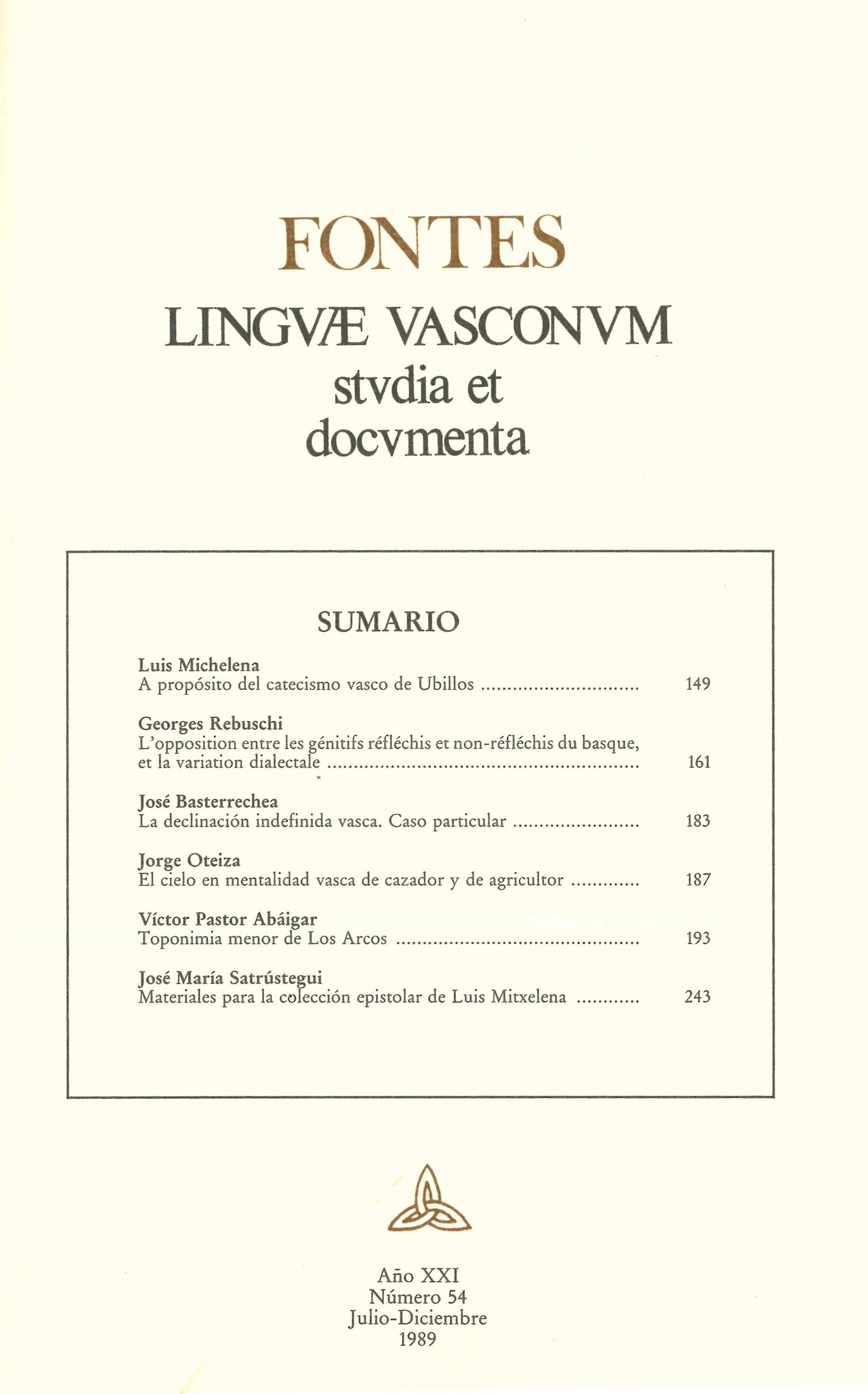
L'opposition entre les génitifs réfléchis et non-réfléchis du basque, et la variation dialectale
Abstract
Whereas the syntactic domain within which the pure pronominal possessive haren 'his' must be free remains stable in almost every dialect, the domain within which its reflexive or anaphoric counterpart bere must be bound seems to vary along the following lines:
(a) three distinct binding domains are distinguished,
- (i) Dø, the minimal category with a subject which contains it;
- (ii) D1, the mínimal category which contains Dø and a(nother) subject;
- (iii) DR, the root sentence;
(b) three groups of dialects are recognized, in which bere (by definition free in Dø, the NP which it specifies), must be either:
- (i) bound in D1, or
- (ii) free or bound in D1, but bound in DR, or
- (iii) either free or bound within both D1 and DR.
On the other hand, haren must always be free in Dø , and almost always in D1 (which is shown not to correspond exactly to the binding category defined according to the notion of B.T. compatibility), but may be either free or bound in DR, if the latter domain is distinct from D1.
Finally, empty pronouns, whether possessive or not, just like the would-be «emphatic» pronoun bera, merely have to be free in Dø (and therefore behave like English he or his).
##about.statistics##
References
ALTUBE, S. 1929: Erderismos; Euskera, n.º spécial, 10-4; rééd. facsim., 1975, Bilbao, lndauchu.
CHOMSKY, N. 1986a: Knowledge of Language; New York, Praeger.
CHOMSKY, N. 1986b: Barriers; Cambridge (Mas.), MIT Press.
EUSKALTZAINDIA [ Académie basque] 1985: Euskal gramatika. Lehen urratsak [E. G.L. U.]; Pampelune, Institución Príncipe de Viana & Euskaltzaindia.
Heath, J. 1974: «Sorne Related Transformations in Basque», in M. W. La Galy et al. (éds.), Papers from the Tenth Regional Meeting; Chicago, C.L.S., 248-258.
HELLAN, L. 1988: Anaphora in Norwegian and the Theory of Grammar. Dordrecht, Foris. https://doi.org/10.1515/9783110849134
LAFITTE, P. 1962: Grammaire basque (navarro-labourdin littéraire); Bayonne, Editions des Amis du Musée Basque et Ikas (1e édition: 1944, Bayonne, Le Livre].
LIÇARRAGUE, J. 1571: lesus Christ gure launaren Testamentu berria; La Rochelle, Pierre Hautin imprimeur; rééd. facsim. 1979, Saint-Sébastien, Hordago-Lur.
MILNER, J.-C. 1978: « Le systeme réfléchi en latín»; Langages 50, 73-86. https://doi.org/10.3406/lgge.1978.1948
MONHANAN, K. P. 1982: 'Grammatical Relations and Anaphora in Malayalam'; MIT Working Papers in Linguistics, 4, 190.
ORTIZ DE URBINA, J. 1986: Some Parameters in the Grammar of Basque; these, Université de l'Illinois a Urbana-Champaign.
OYHARÇABAL, B. 1987: Etude descriptive de constructions complexes en basque [ ... ]; these de doctorat d'Etat, Université de Paris VII.
PICA, P. à.p.: «On the Nature of the Reflexivization Cycle»; Proceedings of the '86 NELS Conference, G.S.L.A., Université du Massachusetts a Amherst.
RAPPAPORT, G. C. 1986: «On Anaphor Binding in Russian»; Natural Language and Linguistic Theory 4-1, 97-120. https://doi.org/10.1007/BF00136266
REBUSCHI, G. 1985: «Théorie du liage et langues non-configurationnelles: quelques données du basque navarro-labourdin»; Euskera 30-2, 389-433.
REBUSCHI, G. 1986a: «Théorie du liage, diachronie et énonciation: sur les ananphores possessives du basque»; ASJU 20-2, 325-421.
REBUSCHI, G. 19866: «Pour une représentation syntaxique duale: structure syntagmatique et structure lexicale en basque»; ASJU 20-3.
REBUSCHI, G. 1987: «Defining the Three Binding Domains of Basque»; comm. au 2e Congres modial basque, Saint Sébastien, sept. 87; a par. in ASJU.
REBUSCHI, G. 1989: «Note sur les pronoms dits 'intensifs' du basque»; in J. Haritschelhar (éd.), · Hommage au Musée Basque; Bayonne, Editions des Amis du Musée Basque, 473-494.
REBUSCHI, G. [ sous presse]: «Binding at LF vs. Obligatory (Counter-) coindexation at SS; a Case Study»; in J. A. Lakarra (éd.), Koldo Mitxelena in memoriam, Saint-Sébastien, Publicaciones del Seminario de Filología Vasca «Julio de Urquijo».
ROTAETXE, K. 1978: Estudio estructural del euskara de Ondárroa, Durango, Leopoldo Zugaza.
SALABURU, P. 1985: «Mario Bunge-ren hizkuntzalaritza»; Euskera 30-2, 297-330.
SALABURU, P. 1986: «La teoría del ligamiento en la lengua vasca»; ASJU 20-2, 359-412.
SARASOLA, I. 1980: «Nire / neure, zure / zeure literatur tradizioan»; Euskera 25-2, 431-446.
SPORTICHE, D. 1986: «Zivum; LI 17-3, 369-374. https://doi.org/10.3928/1542-8877-19860601-10
VILLASANTE, L. 1975: «Hitzaurre gisa», préface [en basque] a la rééd. de Altube (1929).
Copyright (c) 1989 George Rebuschi

This work is licensed under a Creative Commons Attribution-NonCommercial 4.0 International License.